



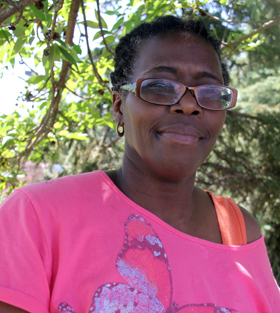
1199SEIU Member Spotlight: Eloise Downs, C.N.A. at Capital Living
June 17, 2015
When she heard last winter that short staffing, a lack of supplies and a disrespectful management were problems that interfered with workers’ ability to provide care at Baptist Nursing Home, it was clear to Eloise Downs that these caregivers needed a union. Eloise, who works as a C.N.A. a few miles away at Capital Living Nursing Home in Schenectady, New York, was already a member of 1199SEIU, United Healthcare Workers East. Several months later, 160 workers at Baptist voted to become members of 1199SEIU – and Eloise Downs was there.
Eloise, a veteran C.N.A. who has worked in the area for more than 28 years said, “There are so many reasons I wanted to help the folks at Baptist. Member to member organizing is important and I’m proof. We must share our stories and our struggles and continue to pass along our victories. That’s how we’re going to build union density in the region,” she said. “The more union members we have, the more strength we have to raise standards for all nursing home workers in this area, and beyond.”
Decades ago, Downs began what eventually became her “career of taking care of people who need it,” as a Program Director for the Boys Club in Schenectady. “I liked that job—it was important,” she said. “But, I always wanted to go into nursing. It’s what I studied. So, when the opportunity came to stay in the neighborhood and work at Hallmark Nursing Home, I jumped in. And I’ve been caring for the frail and the elderly ever since.”
Eloise, a veteran C.N.A. who has worked in the area for more than 28 years said, “There are so many reasons I wanted to help the folks at Baptist. Member to member organizing is important and I’m proof. We must share our stories and our struggles and continue to pass along our victories. That’s how we’re going to build union density in the region,” she said. “The more union members we have, the more strength we have to raise standards for all nursing home workers in this area, and beyond.”
As many nursing home workers do, Eloise had to provide for her own family at the same time she cared for others. She raised her son Denzel, who is now 21 and studying data system management at the Rochester Institute of Technology (RIT). When he was growing up, he was frequently sick with asthma, but Eloise couldn’t afford the health insurance offered by her employer. “Thank goodness we qualified for the state’s Child Health program,” she said. “Still, in the front of my mind, I was always thinking that people who take care of other people’s health should be able to have affordable health benefits for themselves.”
In the mid-2000’s Hallmark Nursing Home went up for sale. Word traveled quickly that jobs were on the chopping block. “None of us had job security. We realized we had no voice in the workplace. We were all scared. My son was still at home. And anyway, I loved my job,” Eloise said.
There was some buzz around the nursing home about a union that could help workers with issues like job security, fairness at work and even affordable health benefits, but at first, Eloise was reluctant to do anything she thought might jeopardize her job. “I’m not sure what light went on, but I changed my mind. In the break room, I was introduced to 2 people who were nursing home workers and had successfully organized to become 1199 members. They told me their stories. That gave me hope. Other people I worked with were hopeful too. And the rest is history.”
The situation at what is now called Capital Living (formerly Hallmark and The Avenue) has improved enormously over the last decade, even through chaotic times of changing owners, management, facility names and even buildings, according to Downs. “Through this, we had a collective bargaining agreement – a legal contract that protects our rights, guarantees wages and benefits and even provides a Training and Upgrading Fund,” she said. Negotiating that first contract was not easy, but you know what? It made us stronger as a group,” she said.
Downs explained that the first contract sets standards that are maintained or even improved each time the agreement is renegotiated. “When I heard about the problems the workers at Baptist were having, I knew they deserved the same things we have. We do the same jobs, and we face the same issues. We tell the same stories. So I volunteered my own time to talk to the workers there. I listened to their stories and I told them mine. Same as folks did with me. Now, I know there is a common solution and that is to organize a union and negotiate a contract,” she said. “And I will share that in every way I can.”
Helping other workers organize is not the only item on the to-do list of Eloise Downs. She wants to use the Training and Upgrading Fund, available to her through her contract, and complete a degree program in Human Services offered at Schenectady Community College. “I also might start my own business baking,” she said. “Oh, and dancing, I love to dance and I have to do that more often.”