



JESSE JACKSON WAS ONE OF OUR GREATEST ALLIES
May 28, 2026
By Dennis Rivera
1199 President, 1989-2007
I first met the Rev. Jesse Louis Jackson Sr. when I volunteered for his 1984 campaign for the Democratic presidential nomination. That was only a short time after I heard him speak at a rally called to end the U.S. Navy’s decades-long practice of bombing and destroying the Puerto Rican island of Vieques. As Jesse addressed the crowd I was struck by his stage presence, his oratory and his grasp of the issues.
When I learned of his passing in February, the news struck me like a thunderbolt, although I knew that he had been gravely ill. His death reminded me how important he was in my life as well as the life of our Union.
Shortly after our Save Our Union slate won the Union leadership, we asked Jesse to join the campaign to raise the dreadful standards for our recently organized homecare workers. Cardinal John Joseph O’Connor, the Archbishop of New York, agreed to meet with Jesse and to join our crusade.
The Cardinal’s and Jesse’s involvement in our campaign, “Invisible No More,” helped these workers, primarily women of color, move out of the shadows and into the daylight. That involvement helped build public and political support and embolden the members.
As a result of the campaign, members were able to more than double their wages, and win healthcare benefits, a small pension, vacation pay and other benefits for the first time.
In 1988, Jesse asked 1199 to use our headquarters for his second run for the presidency. He asked me to take charge of the Latino outreach in the state.
Massachusetts Gov. Michael Dukakis won the state primary, but Jesse won New York City. His campaign galvanized the city’s progressive movement and set the stage for the 1989 mayoral campaign. Many of the “Run, Jesse Run” leaders and activists formed the backbone of David Dinkins’ mayoral coalition. The city’s first Black mayor acknowledged that his victory would not have been possible without the 1988 Jackson campaign.
Later, former President Barack Obama would credit Jesse with paving the path for his 2008 ascension to the highest office in the land.
That same year, 1989, was also my first year as president of our union. Our greatest challenge was negotiations with the NY League of Voluntary Hospitals and Homes. Our leadership determined that we had to hurry to reconstitute our delegate body. In 1984, the former leadership had called out members on a disastrous 47-day strike, and that defeat was fresh in members’ minds.
We decided we had to proceed with caution and set in motion an ambitious plan to reconstitute our delegate body and elect contract captains.
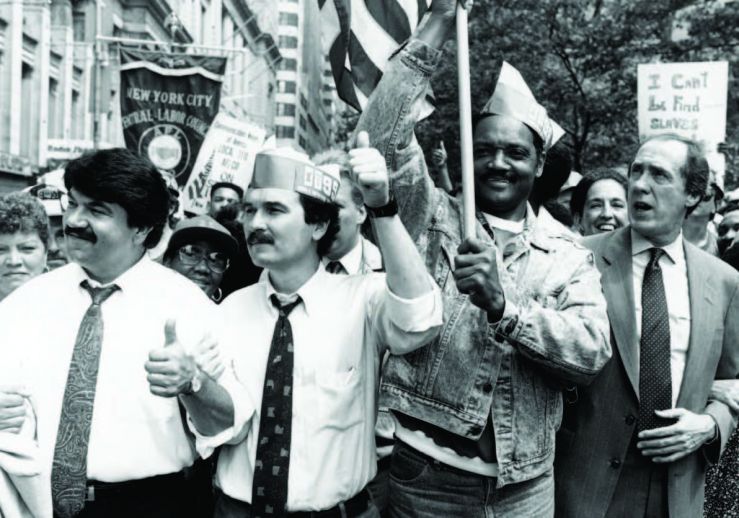
A central component of our contract campaign was a series of one-day strikes. The response was overwhelming. Each action brought tens of thousands of people into the streets. And marching with us was Jesse. He inspired members with chants of “I Am Somebody” and “Keep Hope Alive.”
In the end, this campaign won historic contracts. Key to the victory was Cardinal O’Connor’s early agreement to all of our contract demands. An October 8 New York Times headline read, “Local 1199 is Back. The Hospital Workers Are the Envy of Labor Now.”
I was honored the next year when Jesse asked me to accompany him to South Africa as one of the few Americans to greet Nelson Mandela, the leader of the anti-apartheid movement, after his 27-year imprisonment.
Shortly after that trip, Jesse asked me to become the chair of his Rainbow Coalition, a human and civil rights organization he founded years earlier. In that capacity, I spoke with Jesse regularly, usually at six in the morning, to discuss national and international issues.
Just as he helped David Dinkins become the city’s first Black mayor, Jesse worked with us to help Nydia Velazquez, a Brooklyn Democrat, become the first Puerto Rican women to take a seat in Congress.
Similar to our work with Dr. Martin Luther King on social justice and peace issues, we did much of the same with Jesse. He was a foremost spokesperson for labor rights and workers’ issues. I accompanied Jesse to more meetings with clergy—especially Black ministers—than I’m able to count. I also joined him on farm workers’ campaigns and other social justice struggles. We were arrested together at some of those actions.
Jesse also helped us reclaim our status as champions of peace and solidarity. He and I met with Fidel Castro in Cuba to discuss improving the relationship between the two countries. At the request of Luiz Ignacio Lula da Silva, a labor leader who rose to the presidency of his nation, I accompanied Jesse to Brazil to campaign for Lula throughout the country.
Jesse was not able to join me and other leaders who were arrested in 2001 for protesting the Navy bombing of Vieques. Jacqueline Jackson, Jesse’s wife, joined us at the protest, and spent 10 days in jail on a trespassing charge.
I spent so many hours with Jesse, Jacqueline and their children that I consider them part of my extended family.
It is difficult to measure all that I learned from our discussions and just by watching Jesse. How to talk to news people and effectively use the media are just two examples.
Jesse was an extraordinary man. Like us all, he was not perfect, but his virtues far outweighed his flaws.
My memories of him will always be filled with admiration and love. Our union owes the Rev. Jesse Louis Jackson Sr. an enormous debt of gratitude.
“As a result of the ‘Invisible No More’ campaign, home care members were able to more than double their wages, and win health care benefits, a small pension, vacation pay and other benefits for the first time.”