



The Work We Do: Patient Transport
October 30, 2025
It is natural for patients entering the hospital to feel disoriented and fearful of what may be coming next, as doctors work to treat their injuries and diagnose their conditions. If it is anything more than the most routine outpatient visit, patients will likely encounter an 1199 Patient Transport team member at Mount Sinai Morningside. Whether they require an x-ray, CT-scan, MRI or any of the other tests that are ordered to pinpoint the treatment they need, a friendly face will be ready to get them where they need to be and help to put them at their ease.
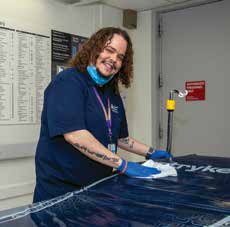
“I had an endoscopy patient last week, who was really on edge and praying. I told her everything was going to be okay. Her husband was there, but she trusted me because I worked there.”
Miranda has begun the pre-requisite courses for a two-year degree program in Radiology. “It’s not costing me anything thanks
to the 1199 Training Fund. I really appreciate the education benefits and room for advancement that I have as part of being an 1199 member.”
Miranda finds his job at Mount Sinai Morningside fulfilling. “It’s not just working, but I feel like I am valuable part of the care team when I’m developing a rapport with patients. Having a positive mindset alters your mood. Getting well is about a mindset.
“Coming from a background in retail and customer service – I find this work to be much more rewarding. I’m helping my community in their time of need. I’m not just selling products. Our hospital doesn’t always get the best reviews. But people really care here.”
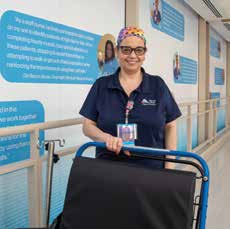
Angell started her career as an 1199 medical interpreter for Visiting Nurse Services, where she worked for 25 years. “I was laid off ten years ago because they brought in iPads,” she says, “It is not the same as having a person interpreting in the room next to you.”
Through the 1199 Job Security Fund, she was able to maintain her salary and benefits and move into Patient Transport 10 years ago.
“COVID was a difficult time here. Everybody was under pressure. It felt like going to war.” says Angell, “We had a refrigerated van outside be-cause the morgue was so backed up. We lost staff members. I did catch it myself, but I bounced back and came back to work.
“Everyone dealt with it differently. I’m a quiet person and I keep it all in. That worked for me. I’m glad it is over, though we still have some COVID pos-itive patients. I have health issues and I’m afraid of catching the virus again.”
The contact she has with patients is her favorite part of the job, which takes her all over the hospital: the ICU; discharge; the morgue; and transport-ing patients to the recovery room after an operation.
“We also take specimens to the lab, and bring stretchers and oxygen tanks downstairs,” she adds, “The CNAs are so short-staffed we some-times help patients into their beds, too”
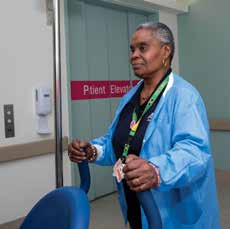
Working with Carlton Latchman in the ER, Weekes believes they make a good team. After all, they’ve been co-workers for 25 years. “At the end of the day, when we put our heads on the pillow, we know that the job we do helped our fellow human beings,” says Weekes, “I feel like we do not get the recognition we deserve, though. Sometimes housekeeping and dietary get recognition, and we are overlooked.”
During the pandemic Weekes and Latchman had to take a lot of patients to the morgue, and it was dangerous. “But no one ever comes to this department and acknowledges what we do. It is a hard job, and I go home beat. I’m 62 and still doing this work.
“Don’t get me wrong. This job is not easy, but I enjoy the excitement. There’s never a dull moment in the ER.
“The things I do and say to the patients to lift their mood is just as much for me as it is for them. It is so important that my day is not consumed by anger and malice.”
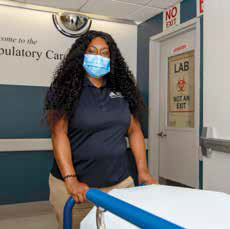
Now an 1199 Delegate, Clarke-Jenkins worked as an Endoscopy Technician for a time but returned to Patient Transport because of the more flexible work schedule and greater interaction with patients.
“I’m often the first person they see. I try to ask them about their day and help them feel more comfortable,” she says.
“I was transporting a patient to an X-ray recently and she wanted to take a photo with her daughter on the internal bridge because thirty years ago she had carried her daughter there as a newborn baby. The patient’s condition was bad, and she didn’t know if she was going to be able to see her daughter again after her upcoming treatment.
“I went to check on her later and she told me, ‘You have no idea what you have done for me and my daughter.’”
“We do what we have to do to transport patients safely,” says Clarke-Jenkins, “But we always like to go the extra mile to make them feel special.”
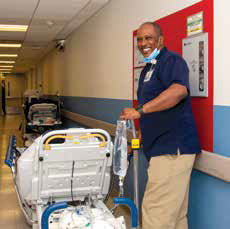
Having worked in Patient Transport for 36 years, Latchman has seen a lot of changes. “The Emergency Room is a more crowded place than it once was, with each nurse often looking after 10-15 patients. I try to support where I can, especially with the elderly patients. We all have parents and grandparents, and they could wind up here too.”
When ER patients need x-rays and CT scans, they go with Latchman. Sometimes he takes them to the third floor for an ultrasound.
Latchman has a few significant life changes on the horizon. He’s due to retire in a couple of years and “I have two twin boys and one just started college at the Fashion Institute of Technology here in Manhattan.
When the time comes to join the every-day-is-a-Saturday-club, “I hope that people recognize how much I have dedicated myself to the patients over all this time,” he says, adding:
“I hope that everyone does not just forget about Carlton.”